No-Upgrade Fast Charger · EVQC / EVFC / EVDC
Fast charging without the utility upgrade.
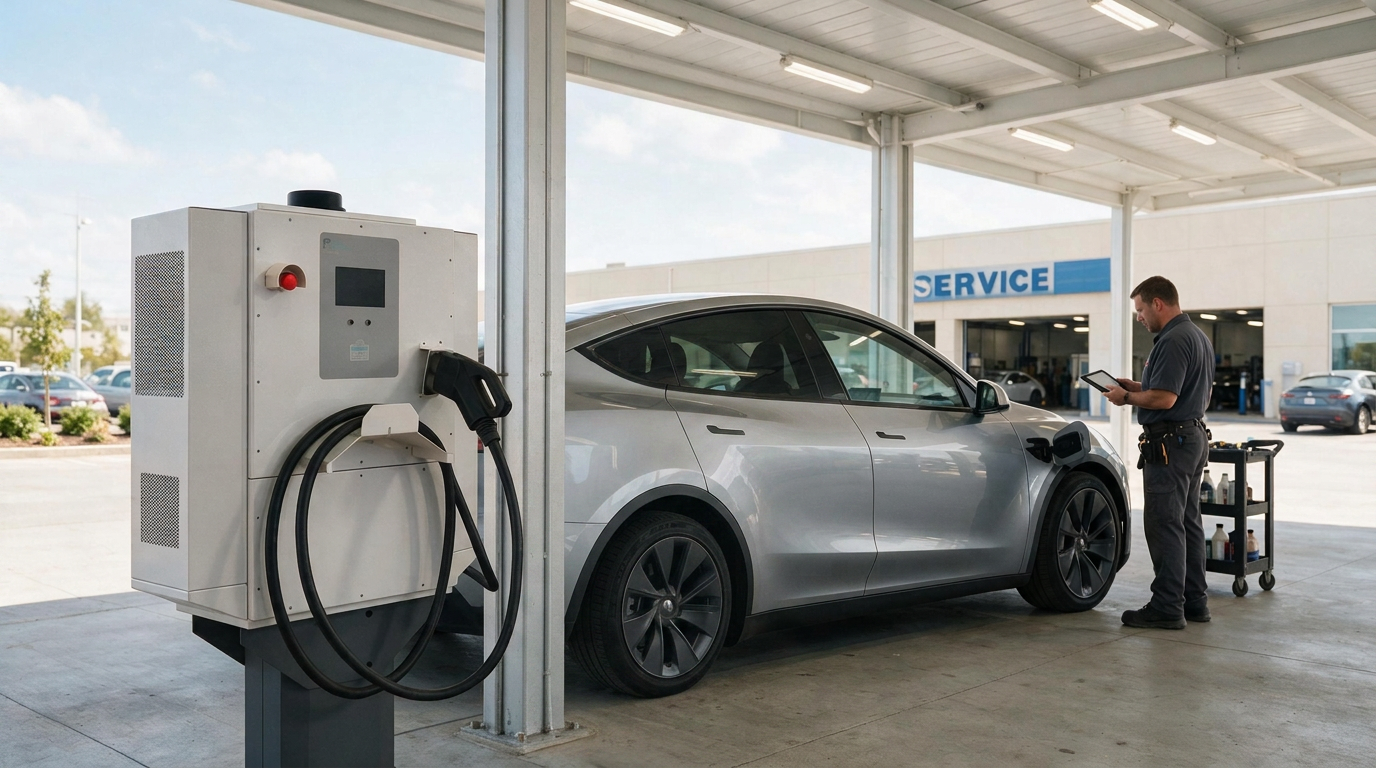
A Level 3 DC fast charger that runs on the electricity your building already has: single-phase, three-phase, or a DC bus. No new service. No transformer. No years on a waiting list. Mounted, wired, and charging at full power in as little as three weeks.
- 250–920 Vdc
- Charges 400 V and 800 V vehicles
- 95%
- Efficiency
- 3 wks
- Stock ships in as little as
- 1M+ hrs
- Demonstrated power-module MTBF
The problem
The charger was never the expensive part.
Ask for fast charging the usual way, and the quote that comes back isn't for a charger: it's for a new utility service, a transformer with a waiting list, and a timeline measured in years. Most projects die right there. Not because the charger cost too much. Because the power did.
How
So we built the charger to fit the building, not the other way around.
Inside every cabinet is a set of patent-pending, field-configurable busbars. Set them for the power you have: 240 V single-phase, 208/240 three-phase, 480/277, even a 120–420 V DC bus, and the charger delivers its full rated power. No derating, no add-on transformer. Changing the input takes about three minutes with the door open.
3 min
To reconfigure the input
What you get
Keep what you already have.
Skip the upgrade entirely
The money you were told to spend on new service stays in your budget. The panel your building already has is enough.
Charging in weeks, not years
Stock units ship in as little as 3 weeks. Your electrician mounts it and wires it to your existing panel: no trenching, no utility construction, no waiting on anyone else.
It won't strand you later
Power modules with a demonstrated million-hour MTBF swap in the field in minutes, and a 24/7 network operations center in Plano, Texas watches every unit we ship.
Any panel
Single-phase in. Full-power DC out.
Most buildings never got three-phase service. With Pii it doesn't matter: both AC configurations, single cable or dual, deliver full-rated DC fast charging from a 240 V single-phase panel, with no derating. What the dual-cable EVFC adds is two vehicles at once, 60 kW per cable.
Three configurations
One charger. Three configurations.
Three configurations, one decision: what power does your building have?
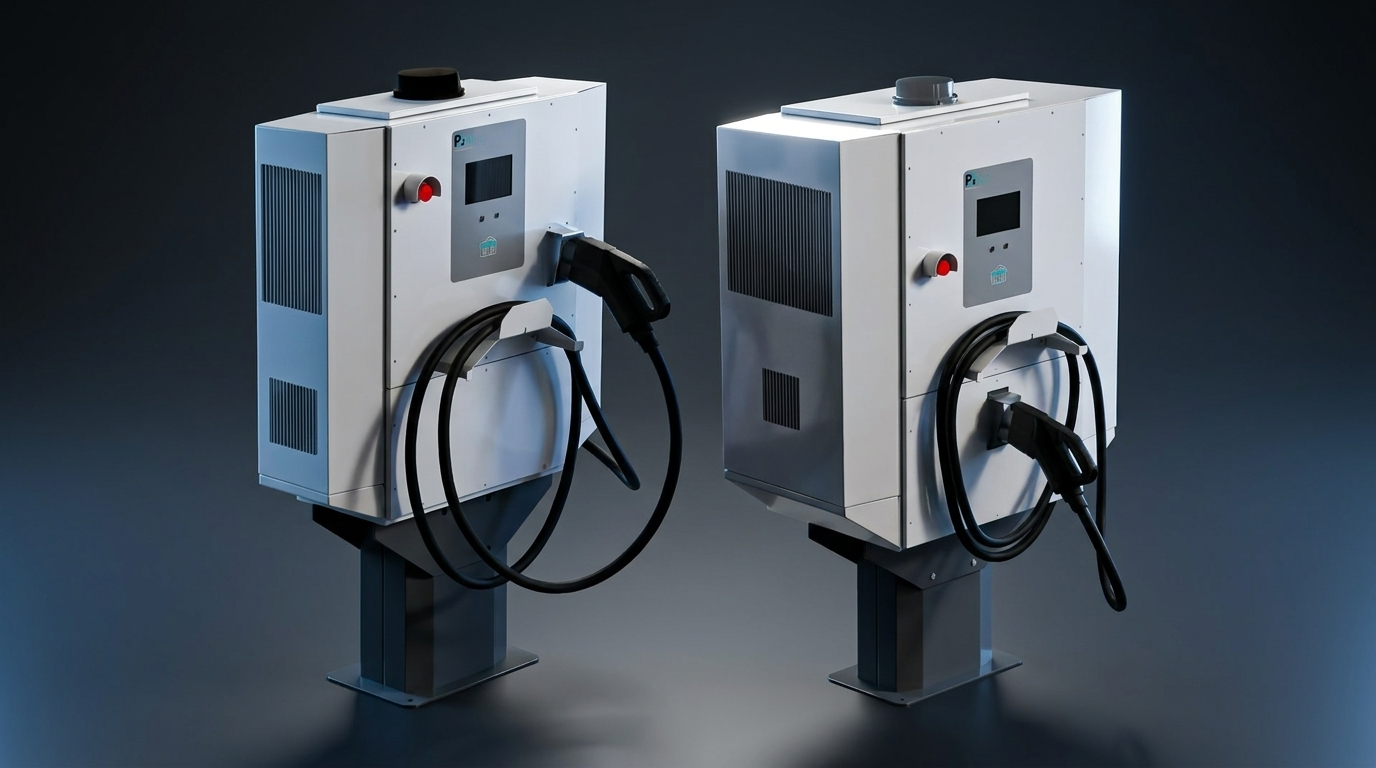
EVQC · 30 & 60 kW
Any-Input · Single Cable
The value pick. Runs on ordinary 240 V single-phase or 208/240 V three-phase, the best-value listed fast charger you can put on the panel you already have.
- 30 / 60 kW
- Continuous output
- 250–920 Vdc
- Output voltage
- 95%
- Efficiency
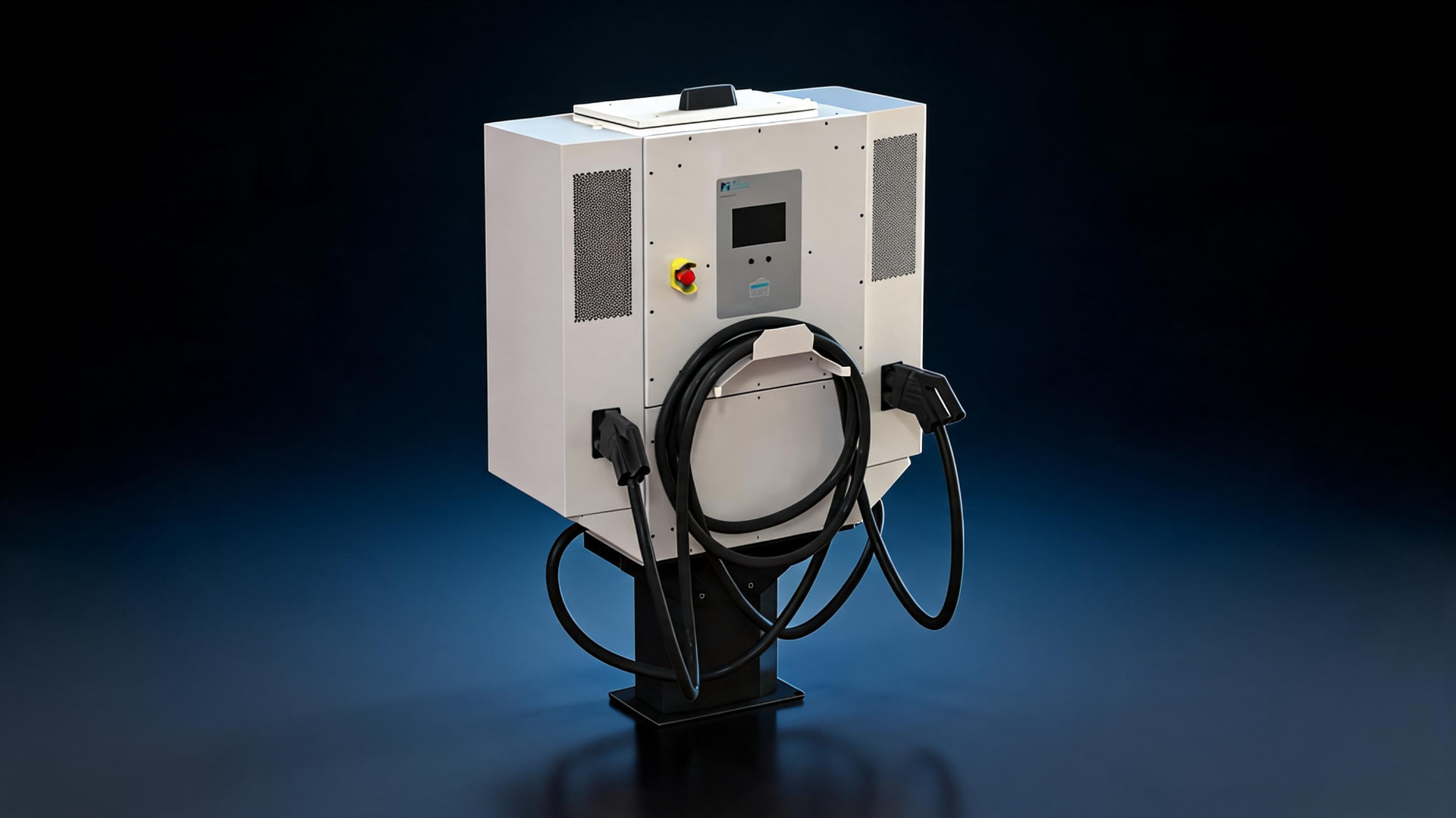
EVFC · 60 kW dual-cable
Any-Input · Dual Cable
Two vehicles at once: 60 kW per cable, or 30/30 kW shared. The same any-input flexibility, twice the throughput at the curb.
- 60 kW
- Per cable
- 30 / 30 kW
- Shared
- 250–920 Vdc
- Output voltage
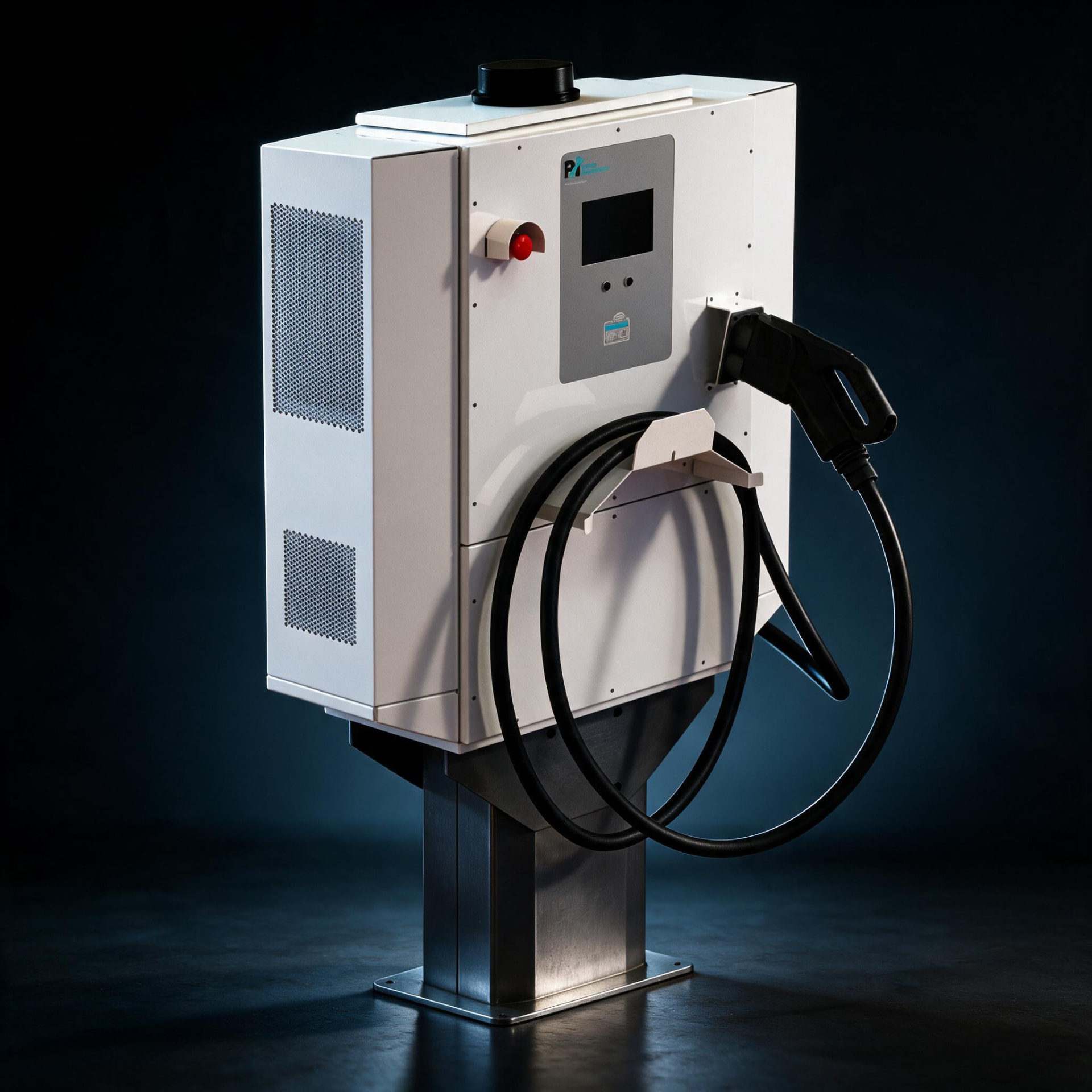
EVDC · 30/60 kW DC-input
DC-Input
If your site already runs a DC bus (solar, storage, industrial), this taps it directly and skips the AC conversion entirely.
- 120–420 Vdc
- Direct DC input
- 30 / 60 kW
- Output power
- 250–920 Vdc
- Output voltage
Financing available through Balboa Capital, the equipment finance arm of Ameris Bank.
What's different
Compare it to the usual.
The way it usually goes: New service, new transformer, a years-long queue.
With Pii: Any panel: single-phase, three-phase, or a DC bus. Patent-pending busbars switch inputs in minutes.
The way it usually goes: Hardware from far away, support from farther.
With Pii: Engineered and assembled in American Fork, Utah. Watched 24/7 from Plano, Texas. BABA-compliant line for federally funded work.
The way it usually goes: Quoted lead times measured in quarters.
With Pii: Stock ships in as little as 3 weeks. Modules swap in the field in minutes.
The way it usually goes: A catalog SKU or nothing.
With Pii: White-label, custom ODM, or listed modules alone: an engineer on the line.
The details
The specification sheet.
Three configurations of one platform. Same output window, same listings, same service model: the difference is what you feed it.
| Specification | Any-Input · Single CableEVQC · 30 & 60 kW | Any-Input · Dual CableEVFC · 60 kW | DC-InputEVDC · 30 / 60 kW |
|---|---|---|---|
| Output power | 30 kW (EVQC030) / 60 kW (EVQC060) continuous | 60 kW per cable, or 30 / 30 kW shared | 30 / 60 kW |
| Output voltage | 250–920 Vdc | 250–920 Vdc | 250–920 Vdc |
| Cables | One | Two | One |
| AC input | 240 Vac single-phase · 208/240 Vac three-phase · 480/277 Vac Wye | 240 Vac single-phase · 208/240 Δ · 480/277 Y | Full flexible Vac |
| DC input | N/A | N/A | Direct 120–420 Vdc |
| Single-phase input | 150 A max (030) / 225 A max (060) | 216–252 V, 225 A max | N/A |
| Delta input | N/A | 195 A max | N/A |
| Wye input | N/A | 85 A max | N/A |
| Derating | None across the input window | None across the input window | No derating above 210 Vdc |
| Efficiency | 95% | N/A | N/A |
| Enclosure | NEMA 3S / IP54 · −30 °C to +50 °C | NEMA 3S / IP54 | NEMA 3S / IP54 |
| Weight | 140 kg (030) / 235 kg (060) | N/A | N/A |
Common to every configuration
- Connectors
- CCS1 + NACS
- Protocols
- DIN 70121 · OCPP 1.6J
- Listing
- cETLus to UL 2202, UL 2231-1 & -2
- Display
- 7" color LCD
- Cooling
- Sealed closed-loop heat exchanger: the power stage never breathes outside air
- Power modules
- Field-replaceable, single-rack swaps, zero-downtime maintenance
- Input busbars
- Field-configurable, no derating (patent pending)
- Firmware
- Remote diagnostics and over-the-air updates
- Payment
- Multiple secure payment and authentication methods
- Monitoring
- 24/7 network operations center, Plano, Texas
- Origin
- Engineered and assembled in American Fork, Utah
- Lead time
- Stock in as little as 3 weeks; standard 3–16 weeks
Documents
Program datasheets
Install & Operate manuals
Program library
Product one-pager
Electrical reference
Find out what your building can do, free.
Send one utility bill and two photos of your electrical panel. Within about a week, an engineer tells you exactly what your service supports, which configuration fits, and what you'd avoid spending. No obligation.