Bi-Directional Charger · EVBC
Charge the bus. Then let the bus power the site.
A 60 kW fast charger that also works in reverse. The same cabinet that fills a vehicle overnight can pull power back out when your site needs it: standard 60 kW in each direction, configurable up to 120 kW combined.
- 60/60
- kW, standard each direction
- 120 kW
- Combined, configurable
- 250–920 Vdc
- Output window
- 1M+ hrs
- Demonstrated MTBF, power topology
The problem
A parked fleet is a warehouse of energy nobody uses.
School buses work a few hours a day. The rest of the time, they're rows of very large batteries sitting in a yard. Until now, all that stored energy has had exactly one job: waiting.
How
One cabinet. Both directions.
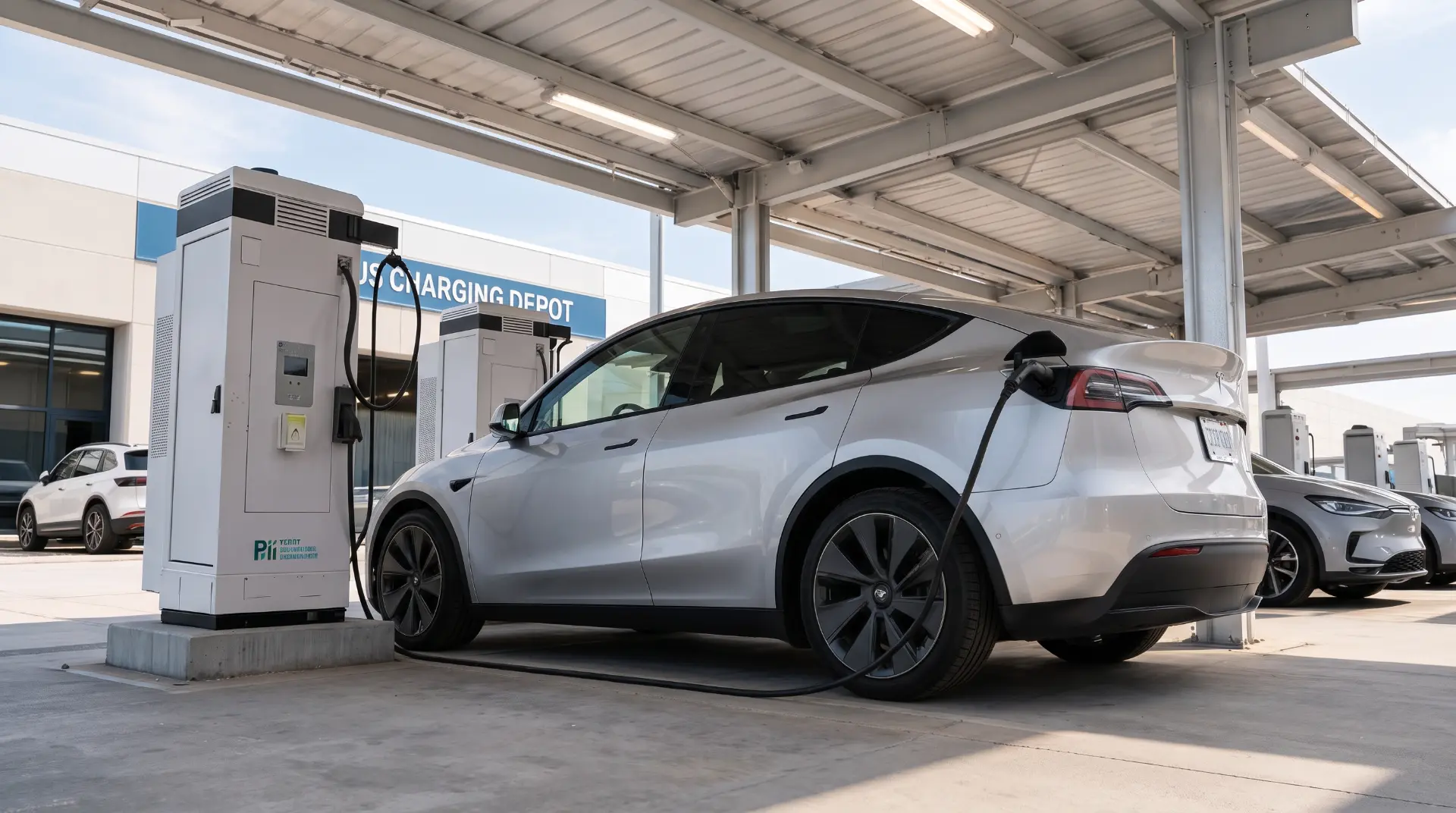
Plug in a V2G-capable vehicle and the EVBC charges it like any fast charger. Reverse the flow, and the vehicle's battery feeds your site instead: 60 kW standard each way, configurable to 70/50 or 80/40 when discharge matters more than charge. The industry calls it vehicle-to-grid, V2G. We call it putting the battery you already bought to work.
2
Directions, one cabinet
What you get
Power both ways.
Backup power you already own
When the site needs power, the fleet you already bought can supply it. The capability lives in the cabinet; how you use it is your energy strategy's call. And because modules replace without a complete system shutdown, your backup source doesn't go dark for maintenance.
Built for bus-yard reality
Sealed cabinet, closed-loop thermal management, NEMA 3R, rated to −35 °C. It lives outside, next to the buses, year-round.
In service, not in theory
Bi-directional school-bus charging is running today at a major student-transport operator. ◇
What's different
Compare it to the usual.
The way it usually goes: New service, new transformer, a years-long queue.
With Pii: Any panel: single-phase, three-phase, or a DC bus. Patent-pending busbars switch inputs in minutes.
The way it usually goes: Hardware from far away, support from farther.
With Pii: Engineered and assembled in American Fork, Utah. Watched 24/7 from Plano, Texas. BABA-compliant line for federally funded work.
The way it usually goes: Quoted lead times measured in quarters.
With Pii: Stock ships in as little as 3 weeks. Modules swap in the field in minutes.
The way it usually goes: A catalog SKU or nothing.
With Pii: White-label, custom ODM, or listed modules alone: an engineer on the line.
The details
The specification sheet.
One cabinet, two directions. Everything below applies to the EVBC6060 in either flow.
| Specification | Bi-Directional · Single CableEVBC6060 · 60 kW each way |
|---|---|
| Function | Charging AND discharging |
| Power | Standard 60/60; configurable to 120 kW combined in/out (e.g., 40 charge/80 discharge, 70/50, 80/40) |
| AC input | 208/240 Δ or 480/277 Y (195 A max on Δ) |
| DC input windows | 290–450 Vdc or 560–900 Vdc |
| Output voltage | 250–920 Vdc |
| Environment | NEMA 3R / IP54 |
Common to every configuration
- Connector
- Single CCS1
- Protocols
- DIN 70121 · OCPP 1.6J
- Standards
- Designed to UL 2202, IEEE 1547.1 and UL 1741-SB
- Cooling
- Sealed closed-loop heat exchanger — the power stage never breathes outside air
- Power modules
- Galvanically isolated rectifiers and inverters, field-replaceable without a full system shutdown
- Connectivity
- Cellular 4G LTE and Wi-Fi — no ethernet drop required
- Firmware
- Remote diagnostics and over-the-air updates
- Monitoring
- 24/7 network operations center, Plano, Texas
- Origin
- Engineered and assembled in American Fork, Utah
- Lead time
- Stock in as little as 3 weeks; standard 3–16 weeks
- Financing
- Available through Balboa Capital, the equipment finance arm of Ameris Bank
Documents
Program datasheets
Install & Operate manual
Program library
Product one-pager
Put the parked fleet to work.
Send one utility bill and two photos of your yard's panel. We'll tell you what your site supports, both directions.