Off-Grid Rescue Charger · EVPC
The fast charger that brings its own power.
30 kW of Level 3 charging with an 82 kWh battery built in. Forklift it into a pickup bed, drive it to the dead EV, the event field, the lot with no service, and charge. Overnight, it refills from any ordinary outlet or Level-2 charger.
- 30 kW
- Output
- 82 kWh
- Battery onboard
- 96%
- Efficiency
- 1M+ hrs
- Demonstrated power-module MTBF
The problem
You can't run a cable to everywhere.
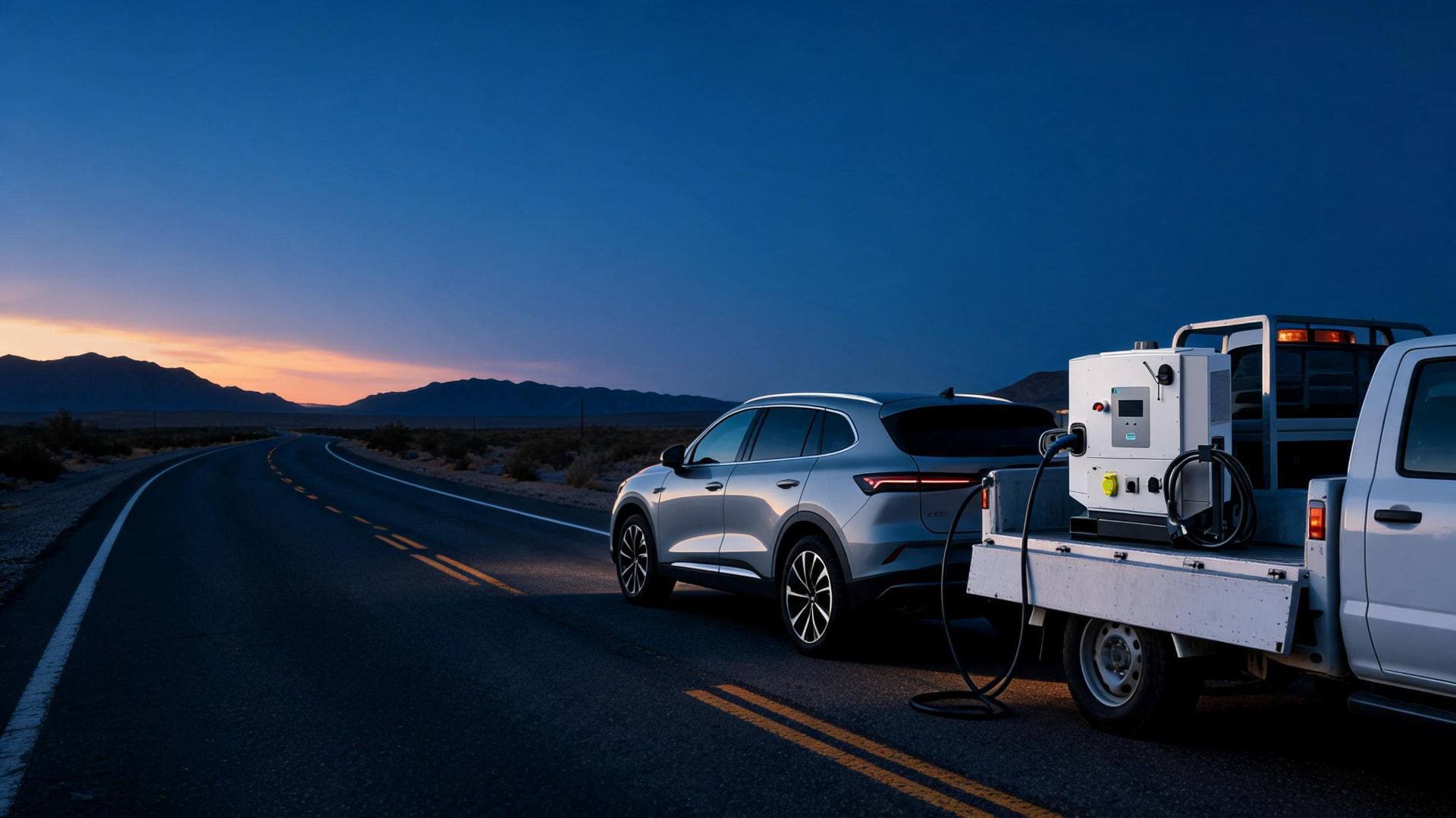
Events get built on fields. Fleets stage in gravel lots. EVs die on highway shoulders at night. In those places there is no panel to wire into. There never will be.
How
The grid stays home. The battery rides along.
82 kWh of LFP storage is built into the skid, so the charger asks nothing of the site: no outlet, no generator, no planning. When the job's done, it refills overnight from single-phase shorepower or any Level-2 charger, and it's ready again by morning.
82 kWh
Onboard: no site power needed
What you get
Power that travels.
Charges where nothing else can
No service, no problem: the energy is already onboard. Full DC fast charging in the middle of a field.
Moves like cargo, not construction
Skid-mounted with forklift pockets, it fits a standard ¾-ton pickup bed. If you can haul a pallet, you can deploy fast charging.
Ready again by morning
It refills from power you already have: a single-phase outlet or any Level-2 charger. No special infrastructure to keep it in service.
What's different
Compare it to the usual.
The way it usually goes: New service, new transformer, a years-long queue.
With Pii: Any panel: single-phase, three-phase, or a DC bus. Patent-pending busbars switch inputs in minutes.
The way it usually goes: Hardware from far away, support from farther.
With Pii: Engineered and assembled in American Fork, Utah. Watched 24/7 from Plano, Texas. BABA-compliant line for federally funded work.
The way it usually goes: Quoted lead times measured in quarters.
With Pii: Stock ships in as little as 3 weeks. Modules swap in the field in minutes.
The way it usually goes: A catalog SKU or nothing.
With Pii: White-label, custom ODM, or listed modules alone: an engineer on the line.
The details
The specification sheet.
One configuration. The charger and its energy travel together: everything below ships in the same skid.
| Specification | Battery-Integrated · Single CableEVPC3082 · 30 kW + 82 kWh |
|---|---|
| Output | 30 kW, 250–920 Vdc, 80 A max |
| Connector | CCS1 5 m |
| Storage | 82 kWh LFP (lithium iron phosphate); 40.8 kWh in 1S/2P |
| Efficiency | 96% |
| Recharge | 240 Vac single-phase shorepower or a Level-2 charger |
| Form | Truly mobile, skid-mounted, off-grid |
| Environment | NEMA 3S / IP54 |
Common to every configuration
- Connector
- CCS1, 5 m cable
- Protocols
- DIN 70121 · OCPP 1.6J
- Transport
- Forklift pockets and lifting hooks; fits a ¾-ton pickup bed or cargo van, no trailer
- Cooling
- Air-to-air heat exchangers: no filters to clog, nothing to service between deployments
- Power modules
- Field-replaceable, single-rack swaps, zero-downtime maintenance
- Firmware
- Remote diagnostics and over-the-air updates
- Monitoring
- 24/7 network operations center, Plano, Texas
- Origin
- Engineered and assembled in American Fork, Utah
- Lead time
- Stock in as little as 3 weeks; standard 3–16 weeks
- Financing
- Available through Balboa Capital, the equipment finance arm of Ameris Bank
Documents
Program datasheets
Install & Operate manual
Program library
Product one-pager
Be the one who shows up with power.
Tell us where it needs to go and what it needs to charge. We'll confirm the fit.